The building
From Romanesque church to Gothic landmark: how St. Stephen's Cathedral was built
The two Romanesque towers, the Gothic nave, the unfinished north tower and the rebuilding after 1945, in the order the English Wikipedia gives them.
Choose a seat category ↗Quick answer
The cathedral grew in layers over some four centuries. A Romanesque church founded in 1137 and dedicated in 1147 was burned in 1258 and replaced by a larger one consecrated in 1263; Gothic choirs, a nave and the south tower followed between 1304 and 1474; and the north tower was left unfinished in 1511. A fire in 1945 destroyed the roof frame, and a full reopening came in 1952. Knowing the sequence helps you read the building when you sit in it for a concert.
The building in dates
| Date | What happened |
|---|---|
| 1137 | Founding, following the Treaty of Mautern |
| 1147 | Dedication to St. Stephen |
| 1258 and 1263 | Fire, then consecration of a larger Romanesque church |
| 1304 to 1340 | Gothic choir built and consecrated |
| 1359 | Rudolf IV lays the cornerstone of the Gothic extension |
| 1433 | South tower completed |
| 1446 to 1474 | Nave vaulted |
| 1511 | Work on the north tower abandoned |
| 1945 to 1952 | Fire, reconstruction, full reopening |
A Romanesque beginning
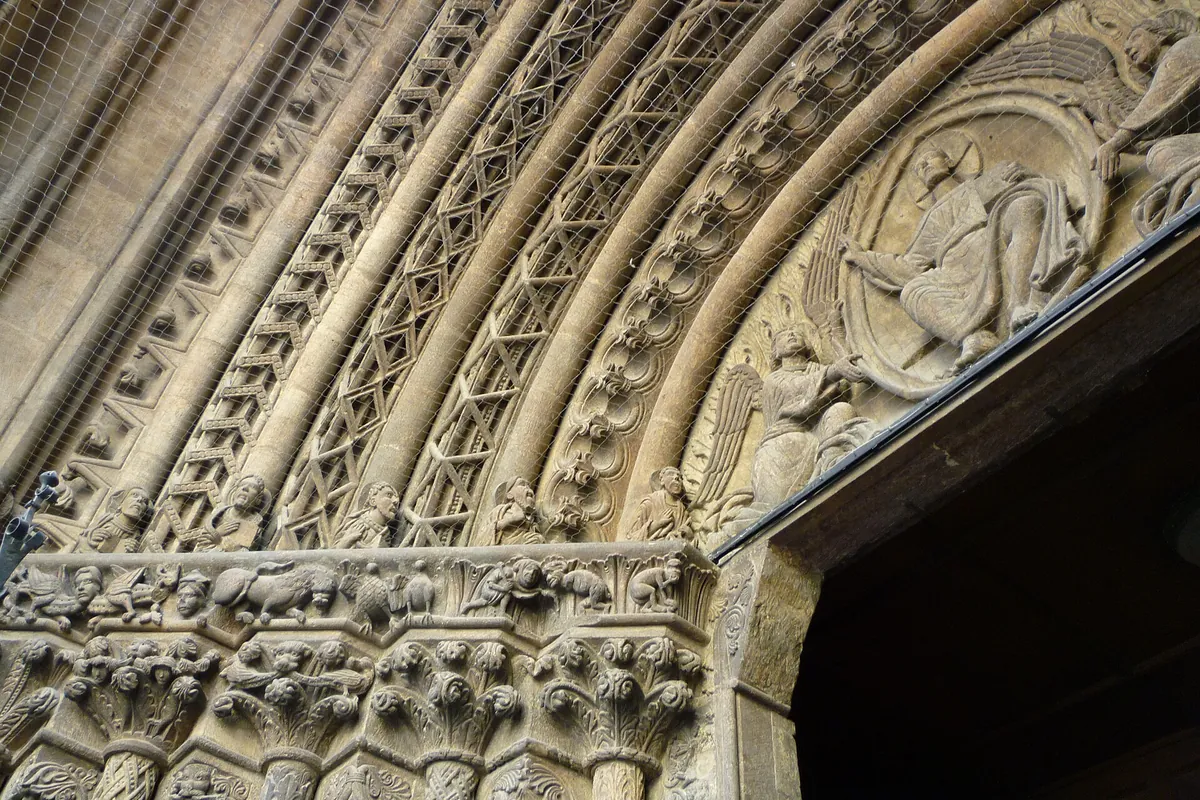
The English Wikipedia says the first church was founded in 1137 after the Treaty of Mautern and dedicated to St. Stephen in 1147, in the presence of Conrad III of Germany and other nobles about to depart on the Second Crusade. Between 1230 and 1245 that church was extended westward, and the present west wall and the two Romanesque towers date from this period. In 1258 a great fire destroyed much of the building, and a larger Romanesque replacement, reusing the two towers, was consecrated on 23 April 1263. The anniversary of that consecration is still marked each year by a three-minute ringing of the great bell.
The oldest stones you can see
The Giant's Door, the main portal on the west front, and the two Roman Towers, known as the Heidentürme, are the oldest parts of the building. The article suggests the portal's name may refer either to a mammoth's thighbone that hung above it for decades or to the funnel shape of the doorway. The towers, each about 65 metres high, take their name from the rubble of older Roman structures used to build them. When you queue to enter for an evening concert, you are standing beneath stonework that was already old when the Gothic builders arrived.
The Gothic choir and Duke Rudolf IV
In 1304 King Albert I ordered a Gothic three-nave choir east of the existing church. His son Duke Albert II continued the work, and the choir was consecrated in 1340. Albert's son Rudolf IV, called the Founder, enlarged the plan. The article records that on 7 April 1359 he laid the cornerstone for a westward Gothic extension near the present south tower, an expansion that would eventually enclose the whole old church. The Wikipedia entry on Rudolf adds that he was trying to rival the cathedral in Prague, and the cathedral article says he set up a chapter of canons at St. Stephen's in 1365.
Nave, vaulting and the south tower
By 1430 the old Romanesque nave had been removed from inside as the new Gothic one rose around it. The south tower, which took 65 years to build, was completed in 1433, and vaulting of the nave took place from 1446 to 1474. The tower rises 136 metres and is known to Viennese as the Steffl. The nave you sit in for a concert is therefore a 15th-century interior, a long, tall room of pointed arches and ribbed vaults that sound travels through in its own way.
The tower that was never finished
A north tower was begun in 1450 under Lorenz Spenning, but the design proved too ambitious as the age of Gothic cathedrals drew to a close, and work stopped in 1511. In 1578 the stump received a Renaissance cap, which the Viennese call the water-tower top. It stands about 68 metres high, roughly half the height of its southern neighbour, which is why the cathedral looks lopsided from some angles. Today the north tower houses the great bell.
The roof and the 1945 fire
The roof is 111 metres long and covered by 230,000 glazed tiles. On the south side they form the double-headed eagle of the Habsburgs, and on the north side the coats of arms of Vienna and Austria. In April 1945, as Soviet troops entered the city, fires started in nearby shops spread to the cathedral, and the wooden roof frame collapsed. Protective brick shells built around the pulpit and other treasures limited the damage to the most valuable art. The article says more than 600 metric tons of steel bracing replaced the timber, and a limited reopening followed on 12 December 1948, with a full reopening on 23 April 1952.
A building that is never finished
The article describes preservation work as continuous since the cathedral's earliest days. The porous limestone weathers, and a permanent workshop of stonemasons repairs and replaces carved elements, helped by laser cleaning and a digital model of the building. That context is useful for visitors: the cathedral you enter for a concert is both a medieval monument and a living workshop, and it has been under care for as long as it has stood.
Frequently asked questions
Why are the two towers different?
The south tower was completed in 1433, while the north tower was abandoned in 1511 and given a Renaissance cap in 1578.
How tall is the south tower?
The English Wikipedia gives 136 metres.
What are the Heathen Towers?
The two Romanesque towers on the west front, named for the Roman rubble used in their construction.
Sources
- The cathedral's own entry in the English Wikipedia: towers, roof, bells and burials
- English Wikipedia entry on Duke Rudolf IV, who began the Gothic nave
- English Wikipedia entry on Vienna's Innere Stadt, the historic first district
- UNESCO's listing for the Historic Centre of Vienna
- English Wikipedia overview of Gothic architecture
- English Wikipedia overview of Romanesque architecture